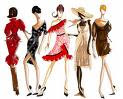
You probably can't recall who said it, but whoever first uttered that fashion comes full circle every 30 years or so was not too far off. This season on the runway is reminiscent of the flowing 70s in both fabric and style. We are seeing much more of the long skirt and much less of the micro mini. Materials like silk and chiffon, which tend to flow and gather, are much more popular for Spring 2008 than fabrics like cotton or denim which tend to hold shape and stay stiffer in appearance. The word for the season is feminine, feminine, feminine! The exception to this seems to be in outerwear, where rubber is oddly back in style. Indoors, though, thin little belts, hats, and scarves are also popular and a throwback to the 70s as well as being womanly. Don't despair, though - some things from last season are still popular and can be recycled for this season. Accessories like metallic bags and clutches, as well as sequins and some of the longer pencil skirts can still be worn with confidence. Dresses with color blocks are still around as well, left over from last season and still cute. Headbands are still a popular accessory as well.
Sheers are in this year as a fabric style, which works well with the flow-y nature of the season. Pairing a sheer shirt over a camisole with denim jeans is a great casual look. In fact, a sheer scarf works with almost anything this season. Especially cute is the above-mentioned shirt and jeans with a little scarf and dressy sneakers. "Dressy sneakers" are another big hit this year, which will keep your feet happy as you get to be comfortable and stylish at the same time. Low-lying, patterned variety sneakers with ties that sport the best of brand names are the most popular for the young trendsetter.
Speaking of patterns, big bold prints such as tropical themes and jungle prints are back. For whatever reason, and it seems to happen every several years, tribal and jungle themes like leopard prints and zebra stripes make their way back to the runway. This year is no exception. Color is back, and black is out, at least for now. Last year, brown was the new black, and this year it is muted silver and grey that's all the rage when you want to opt for a non-color.
What about shoes, you ask? Pointy-toe pumps are back! Not that they ever really went out of style, but they certainly came second to the flip flop, the ballet slipper, and other such cutesy flat footwear, along with the rounded toe pump. Also noteworthy is what's in store for later on in the season. Fall 2008 promises to be chock full of the "bigger is better" theory. Bigger, chunkier heels, bigger, longer boots, and bigger and heavier accessories on the shoes themselves such as thick buckles and chains should be on your radar for footwear.
Of course, if we are going to talk shoes we must talk shades. Still popular, especially with the Divas, are the ever-present round and dark sunglasses that cover most of your face. The celebrities, of course, brought this trend to the forefront of fashion and it doesn't look like it's going anywhere anytime soon. Also popular though, is the blue lens which seemed to disappear for a while. This lens is more appropriate with a smaller frame than with the oversized shades discussed. The RayBan Wayfarers, so popular in the 80s, also seem to be making a comeback this year.
Last but by no means least, there could not be a fashion article written about what's hot for 2008 without mentioning jeans. Designer denim continues to be the hottest thing around. We all know that True Religion, Citizens of Humanity, Buffalo, Seven for all Mankind and Lucky have become standard, almost run-of-the mill designer jeans. Even though they cost upward of $200.00, they are still the 'norm'. Slightly more pricey is Diesel, and this brand continues to be popular as well. Relative newcomers, though, are some of the names that were actually around long before these newbies even existed. Yves St. Laurent, Donna Karan, and some of the more elite designer's names are being plastered on the derrieres of the most discriminating fashionistas this season. As for jean style and cut, the zipper-ankle and straight-leg varieties that were popular in the 80s are making a comeback. Expect to see them on the legs of the trendsetters this fall.
This season proves to be an interesting and eclectic mix of 70s and 80s styles. This may seem contradictory, but the feminine nature of the season's styles pulls from flowing 70s fabrics and cuts and seems to just use a hint of 80s metal and accessory - and it's a hit.
About The Author
Megan Hazel is a freelance writer who writes about trends and fashion topics, similar to what consumers read in http://www.magazines.com/ncom/mag?mid=2632 Lucky Magazine
Read rest of these entry........>>>
Showing posts with label Fashion. Show all posts
Showing posts with label Fashion. Show all posts
Wedding Fashion Style
Some girls dream of being a romantic princess bride, some want to stand out from the crowd, some leave it until the last minute and make a spontaneous decision while the rest of us don’t know what we want to wear until we see it! But before you start the search for that perfect frock, take some time out and look at the BIG Picture – be your own wedding stylist!
For both brides and grooms, there are so many factors to consider when deciding what to wear on your wedding day. Think about your own style and personality, your colourings, your figure type, your budget, the weather, the setting, religious obligations, your families’ expectations and traditions.
All of these factors are extremely important and need to be looked at before you try on your first gown.
But there is also another angle that is worth considering - the overall “look” and “image” that you want to project on your special day. Set up a theme or flavour that will run consistently throughout the event, from the bridal party fashions, to the ceremony, the flowers, the décor, the music, the food and the overall atmosphere. Professional wedding planners can be employed to assist you in this sometimes daunting and difficult task, but with a bit of imagination and lots of brain-storming, you and your partner can create a theme that will reflect your tastes and personalities and result in a harmonious and unique wedding which will linger in the memories of your guests forever!
What does this wedding truly mean to you and your partner? What does it represent? How do you want to feel on the day? What emotions do you want to stir up in the hearts of your friends and families? How do you want them to celebrate your declarations of love? How do you want them to remember this very special occasion? Sit down with your partner and write a list of words that pop into your mind when you think about your wedding. Play a game of word association and see where it takes you! Perhaps you could both write separate lists, then compare them and find the words that match up, the key ideas that you both share… this is a fun way to find a common thread which will lead you to your theme.
Deciding on a theme is not as simple as picking a colour. And putting that theme into action requires skillful co-ordination and careful consideration. Imagine you are a movie director, and you are planning a scene which is integral to the storyling.things must make sense and be logical, so the audience will understand what it is that you are trying to say. The set, costumes, lighting and dialogue must provoke a mood. The look must be visually stimulating and encourage the audience to behold its beauty and enjoy the feelings that it conjures up inside them.
It’s a similar scenario for a well-organised wedding and whether you like it or not, the bride and groom are the stars of this show and are expected to perform and delight the audience in their own unique way!
Once you and your partner come up with your own theme, choosing your wedding outfits will suddenly seem so much easier … just ask yourself if that gown or that tailored suit will fit into the theme. Try to visit a variety of boutiques and try on as many different styles as you can, to help you decide on colour and shape.
Once you narrow down your possibilities, or at least decide what you DON’T like, the real search can begin! For brides, you should start looking at least 6 months before the wedding, and grooms will need at least 3 months. Remember that the best suppliers tend to be booked out for months in advance, so get in early to avoid disappointment!
Try researching in a variety of media the internet, bridal magazines, local directories, bridal fairs and trade shows, and ask around for recommendations from friends and family. Set a budget for each outfit, and stick to it as much as possible (but don’t be surprised when it blows out!) Most importantly, you must feel comfortable with your selection – don’t choose something that does not suit your own personal style, otherwise you will appear awkward and will not look yourself on the big day.
Make sure you and your partner decide on your own outfits first, before choosing what your attendants will wear. Everything revolves around the two of you, and don’t you forget it! When thinking about your bridesmaids, remember that long full length dresses and “up” hair-do’s will always look much more formal than shorter hemlines and wearing the hair out. Smart accessorizing such as embellished wraps, long gloves and diamante jewellery can dress up an outfit and instantly give it a more formal feel, without breaking the budget.
Read rest of these entry........>>>
For both brides and grooms, there are so many factors to consider when deciding what to wear on your wedding day. Think about your own style and personality, your colourings, your figure type, your budget, the weather, the setting, religious obligations, your families’ expectations and traditions.
All of these factors are extremely important and need to be looked at before you try on your first gown.
But there is also another angle that is worth considering - the overall “look” and “image” that you want to project on your special day. Set up a theme or flavour that will run consistently throughout the event, from the bridal party fashions, to the ceremony, the flowers, the décor, the music, the food and the overall atmosphere. Professional wedding planners can be employed to assist you in this sometimes daunting and difficult task, but with a bit of imagination and lots of brain-storming, you and your partner can create a theme that will reflect your tastes and personalities and result in a harmonious and unique wedding which will linger in the memories of your guests forever!
What does this wedding truly mean to you and your partner? What does it represent? How do you want to feel on the day? What emotions do you want to stir up in the hearts of your friends and families? How do you want them to celebrate your declarations of love? How do you want them to remember this very special occasion? Sit down with your partner and write a list of words that pop into your mind when you think about your wedding. Play a game of word association and see where it takes you! Perhaps you could both write separate lists, then compare them and find the words that match up, the key ideas that you both share… this is a fun way to find a common thread which will lead you to your theme.
Deciding on a theme is not as simple as picking a colour. And putting that theme into action requires skillful co-ordination and careful consideration. Imagine you are a movie director, and you are planning a scene which is integral to the storyling.things must make sense and be logical, so the audience will understand what it is that you are trying to say. The set, costumes, lighting and dialogue must provoke a mood. The look must be visually stimulating and encourage the audience to behold its beauty and enjoy the feelings that it conjures up inside them.
It’s a similar scenario for a well-organised wedding and whether you like it or not, the bride and groom are the stars of this show and are expected to perform and delight the audience in their own unique way!
Once you and your partner come up with your own theme, choosing your wedding outfits will suddenly seem so much easier … just ask yourself if that gown or that tailored suit will fit into the theme. Try to visit a variety of boutiques and try on as many different styles as you can, to help you decide on colour and shape.
Once you narrow down your possibilities, or at least decide what you DON’T like, the real search can begin! For brides, you should start looking at least 6 months before the wedding, and grooms will need at least 3 months. Remember that the best suppliers tend to be booked out for months in advance, so get in early to avoid disappointment!
Try researching in a variety of media the internet, bridal magazines, local directories, bridal fairs and trade shows, and ask around for recommendations from friends and family. Set a budget for each outfit, and stick to it as much as possible (but don’t be surprised when it blows out!) Most importantly, you must feel comfortable with your selection – don’t choose something that does not suit your own personal style, otherwise you will appear awkward and will not look yourself on the big day.
Make sure you and your partner decide on your own outfits first, before choosing what your attendants will wear. Everything revolves around the two of you, and don’t you forget it! When thinking about your bridesmaids, remember that long full length dresses and “up” hair-do’s will always look much more formal than shorter hemlines and wearing the hair out. Smart accessorizing such as embellished wraps, long gloves and diamante jewellery can dress up an outfit and instantly give it a more formal feel, without breaking the budget.
Read rest of these entry........>>>
Label:
Fashion
Fashion Changes
The History of fashion
The habit of people continually changing the style of clothing worn, which is now worldwide, at least among urban populations, is generally held by historians to be a distinctively Western one.At other periods in Ancient Rome and other cultures changes in costume occurred, often at times of economic or social change, but then a long period without large changes followed. In 8th century Cordoba, Spain, Ziryab, a famous musician - a star in modern terms - is said to have introduced sophisticated clothing styles based on seasonal and daily timings from his native Baghdad and his own inspiration.
English caricature of Tippies of 1796The beginnings of the habit in Europe of continual and increasingly rapid change in styles can be fairly clearly dated to the middle of the 14th century, to which historians including James Laver and Fernand Braudel date the start of Western fashion in clothing.The most dramatic manifestation was a sudden drastic shortening and tightening of the male over-garment, from calf-length to barely covering the buttocks, sometimes accompanied with stuffing on the chest to look bigger. This created the distinctive Western male outline of a tailored top worn over leggings or trousers which is still with us today.
Marie Antoinette was a major fashion icon during the late 18th century.The pace of change accelerated considerably in the following century, and women and men's fashion, especially in the dressing and adorning of the hair, became equally complex and changing. Art historians are therefore able to use fashion in dating images with increasing confidence and precision, often within five years in the case of 15th century images.Initially changes in fashion led to a fragmentation of what had previously been very similar styles of dressing across the upper classes of Europe, and the development of distinctive national styles, which remained very different until a counter-movement in the 17th to 18th centuries imposed similar styles once again, finally those from Ancien Régime in France.Though fashion was always led by the rich, the increasing affluence of early modern Europe led to the bourgeoisie and even peasants following trends at a distance sometimes uncomfortably close for the elites - a factor Braudel regards as one of the main motors of changing fashion.
The fashions of the West are generally unparalleled either in antiquity or in the other great civilizations of the world. Early Western travellers, whether to Persia, Turkey, Japan or China frequently remark on the absence of changes in fashion there, and observers from these other cultures comment on the unseemly pace of Western fashion, which many felt suggested an instability and lack of order in Western culture. The Japanese Shogun's secretary boasted (not completely accurately) to a Spanish visitor in 1609 that Japanese clothing had not changed in over a thousand years. However in Ming China, for example, there is considerable evidence for rapidly changing fashions in Chinese clothing, Albrecht Dürer's drawing contrasts a well turned out bourgeoise from Nuremberg (left) with her counterpart from Venice, in. The Venetian lady's high chopines make her taller.Ten 16th century portraits of German or Italian gentlemen may show ten entirely different hats, and at this period national differences were at their most pronounced, as Albrecht Dürer recorded in his actual or composite contrast of Nuremberg and Venetian fashions at the close of the 15th century.
The "Spanish style" of the end of the century began the move back to synchronicity among upper-class Europeans, and after a struggle in the mid 17th century, French styles decisively took over leadership, a process completed in the 18th century.Though colors and patterns of textiles changed from year to year,the cut of a gentleman's coat and the length of his waistcoat, or the pattern to which a lady's dress was cut changed more slowly. Men's fashions largely derived from military models, and changes in a European male silhouette are galvanized in theatres of European war, where gentleman officers had opportunities to make notes of foreign styles: an example is the "Steinkirk" cravat or necktie.The pace of change picked up in the 1780s with the increased publication of French engravings that showed the latest Paris styles; though there had been distribution of dressed dolls from France as patterns since the 16th century, and Abraham Bosse had produced engravings of fashion from the 1620s. By 1800, all Western Europeans were dressing alike (or thought they were): local variation became first a sign of provincial culture, and then a badge of the conservative peasant.
Although tailors and dressmakers were no doubt responsible for many innovations before, and the textile industry certainly led many trends, the history of fashion design is normally taken to date from 1858, when the English-born Charles Frederick Worth opened the first true haute couture house in Paris. Since then the professional designer has become a progressively more dominant figure, despite the origins of many fashions in street fashion.Modern Westerners have a wide choice available in the selection of their clothes. What a person chooses to wear can reflect that person's personality or likes. When people who have cultural status start to wear new or different clothes a fashion trend may start. People who like or respect them may start to wear clothes of a similar style.
Fashions may vary considerably within a society according to age, social class, generation, occupation sexual orientation, and geography as well as over time. If, for example, an older person dresses according to the fashion of young people, he or she may look ridiculous in the eyes of both young and older people. The terms fashionista or fashion victim refer to someone who slavishly follows the current fashions. A new term originated in the USA during the economic difficulties of 2008: recessionista combining the words recession and fashionista. Recessionista may be defined as: a person who strives to remain fashionable on a minimal budget.One can regard the system of sporting various fashions as a fashion language incorporating various fashion statements using a grammar of fashion.
Changes
In youth subculture fashion is sometimes used to flout previously-held societal norms, such as by wearing pants low to expose underwear. Fashion, by description, changes constantly. The changes may proceed more rapidly than in most other fields of human activity (language, thought, etc).For some, modern fast-paced changes in fashion embody many of the negative aspects of capitalism: it results in waste and encourages people qua consumers to buy things unnecessarily. Other people enjoy the diversity that changing fashion can apparently provide, seeing the constant change as a way to satisfy their desire to experience "new" and "interesting" things. Note too that fashion can change to enforce uniformity, as in the case where so-called Mao suits became the national uniform of mainland China.
At the same time there remains an equal or larger range designated 'out of fashion'.Practically every aspect of appearance that can be changed has been changed at some time, for example skirt lengths ranging from ankle to mini to so short that it barely covers anything, etc. In the past, new discoveries and lesser-known parts of the world could provide an impetus to change fashions based on the exotic: Europe in the eighteenth or nineteenth centuries, for example, might favor things Turkish at one time, things Chinese at another, and things Japanese at a third. A modern version of exotic clothing includes club wear. Globalization has reduced the options of exotic novelty in more recent times, and has seen the introduction of non-Western wear into the Western world.Fashion houses and their associated fashion designers, as well as high-status consumers (including celebrities), appear to have some role in determining the rates and directions of fashion change.
Read rest of these entry........>>>
The habit of people continually changing the style of clothing worn, which is now worldwide, at least among urban populations, is generally held by historians to be a distinctively Western one.At other periods in Ancient Rome and other cultures changes in costume occurred, often at times of economic or social change, but then a long period without large changes followed. In 8th century Cordoba, Spain, Ziryab, a famous musician - a star in modern terms - is said to have introduced sophisticated clothing styles based on seasonal and daily timings from his native Baghdad and his own inspiration.
English caricature of Tippies of 1796The beginnings of the habit in Europe of continual and increasingly rapid change in styles can be fairly clearly dated to the middle of the 14th century, to which historians including James Laver and Fernand Braudel date the start of Western fashion in clothing.The most dramatic manifestation was a sudden drastic shortening and tightening of the male over-garment, from calf-length to barely covering the buttocks, sometimes accompanied with stuffing on the chest to look bigger. This created the distinctive Western male outline of a tailored top worn over leggings or trousers which is still with us today.
Marie Antoinette was a major fashion icon during the late 18th century.The pace of change accelerated considerably in the following century, and women and men's fashion, especially in the dressing and adorning of the hair, became equally complex and changing. Art historians are therefore able to use fashion in dating images with increasing confidence and precision, often within five years in the case of 15th century images.Initially changes in fashion led to a fragmentation of what had previously been very similar styles of dressing across the upper classes of Europe, and the development of distinctive national styles, which remained very different until a counter-movement in the 17th to 18th centuries imposed similar styles once again, finally those from Ancien Régime in France.Though fashion was always led by the rich, the increasing affluence of early modern Europe led to the bourgeoisie and even peasants following trends at a distance sometimes uncomfortably close for the elites - a factor Braudel regards as one of the main motors of changing fashion.
The fashions of the West are generally unparalleled either in antiquity or in the other great civilizations of the world. Early Western travellers, whether to Persia, Turkey, Japan or China frequently remark on the absence of changes in fashion there, and observers from these other cultures comment on the unseemly pace of Western fashion, which many felt suggested an instability and lack of order in Western culture. The Japanese Shogun's secretary boasted (not completely accurately) to a Spanish visitor in 1609 that Japanese clothing had not changed in over a thousand years. However in Ming China, for example, there is considerable evidence for rapidly changing fashions in Chinese clothing, Albrecht Dürer's drawing contrasts a well turned out bourgeoise from Nuremberg (left) with her counterpart from Venice, in. The Venetian lady's high chopines make her taller.Ten 16th century portraits of German or Italian gentlemen may show ten entirely different hats, and at this period national differences were at their most pronounced, as Albrecht Dürer recorded in his actual or composite contrast of Nuremberg and Venetian fashions at the close of the 15th century.
The "Spanish style" of the end of the century began the move back to synchronicity among upper-class Europeans, and after a struggle in the mid 17th century, French styles decisively took over leadership, a process completed in the 18th century.Though colors and patterns of textiles changed from year to year,the cut of a gentleman's coat and the length of his waistcoat, or the pattern to which a lady's dress was cut changed more slowly. Men's fashions largely derived from military models, and changes in a European male silhouette are galvanized in theatres of European war, where gentleman officers had opportunities to make notes of foreign styles: an example is the "Steinkirk" cravat or necktie.The pace of change picked up in the 1780s with the increased publication of French engravings that showed the latest Paris styles; though there had been distribution of dressed dolls from France as patterns since the 16th century, and Abraham Bosse had produced engravings of fashion from the 1620s. By 1800, all Western Europeans were dressing alike (or thought they were): local variation became first a sign of provincial culture, and then a badge of the conservative peasant.
Although tailors and dressmakers were no doubt responsible for many innovations before, and the textile industry certainly led many trends, the history of fashion design is normally taken to date from 1858, when the English-born Charles Frederick Worth opened the first true haute couture house in Paris. Since then the professional designer has become a progressively more dominant figure, despite the origins of many fashions in street fashion.Modern Westerners have a wide choice available in the selection of their clothes. What a person chooses to wear can reflect that person's personality or likes. When people who have cultural status start to wear new or different clothes a fashion trend may start. People who like or respect them may start to wear clothes of a similar style.
Fashions may vary considerably within a society according to age, social class, generation, occupation sexual orientation, and geography as well as over time. If, for example, an older person dresses according to the fashion of young people, he or she may look ridiculous in the eyes of both young and older people. The terms fashionista or fashion victim refer to someone who slavishly follows the current fashions. A new term originated in the USA during the economic difficulties of 2008: recessionista combining the words recession and fashionista. Recessionista may be defined as: a person who strives to remain fashionable on a minimal budget.One can regard the system of sporting various fashions as a fashion language incorporating various fashion statements using a grammar of fashion.
Changes
In youth subculture fashion is sometimes used to flout previously-held societal norms, such as by wearing pants low to expose underwear. Fashion, by description, changes constantly. The changes may proceed more rapidly than in most other fields of human activity (language, thought, etc).For some, modern fast-paced changes in fashion embody many of the negative aspects of capitalism: it results in waste and encourages people qua consumers to buy things unnecessarily. Other people enjoy the diversity that changing fashion can apparently provide, seeing the constant change as a way to satisfy their desire to experience "new" and "interesting" things. Note too that fashion can change to enforce uniformity, as in the case where so-called Mao suits became the national uniform of mainland China.
At the same time there remains an equal or larger range designated 'out of fashion'.Practically every aspect of appearance that can be changed has been changed at some time, for example skirt lengths ranging from ankle to mini to so short that it barely covers anything, etc. In the past, new discoveries and lesser-known parts of the world could provide an impetus to change fashions based on the exotic: Europe in the eighteenth or nineteenth centuries, for example, might favor things Turkish at one time, things Chinese at another, and things Japanese at a third. A modern version of exotic clothing includes club wear. Globalization has reduced the options of exotic novelty in more recent times, and has seen the introduction of non-Western wear into the Western world.Fashion houses and their associated fashion designers, as well as high-status consumers (including celebrities), appear to have some role in determining the rates and directions of fashion change.
Read rest of these entry........>>>
Label:
Fashion
Subscribe to:
Posts (Atom)